
impact
about
our story
explore our impact
careers and opportunities
join us
open science
sharing science to speed discovery
open science week
celebrating open science
team science
people & teams
discovery is a team effort
advisors
their input shapes our science
board of directors
they help us fulfill our mission
shanahan foundation fellowship
at the interface of data and neuroscience
studio d3 fellowship
contribute bold ideas to redefine discovery
next generation leaders
fostering emerging leaders in bioscience
research
overview
our approach
science at the scale of greatest impact
additional programs
studio d3
data driven discovery
neurobiology of action
revealing the mechanisms behind movement and learning
science accelerators
brain science
building a blueprint of the brain
cell science
understanding how cells become organs
neural dynamics
revealing the brain’s hidden algorithms
immunology
mapping the immune system
synthetic biology
designing biology to advance health
brain health
accelerating human brain research
ai biodesign
unlocking new frontiers of bioscience
education
overview
science education
science is for everyone
open science
sharing science speeds discovery
engagement
education resources
real science. real skills.
field trips
experience science where it happens
educator development
empowering educators
news
overview
all news
explore the latest news
podcast
the human stories behind discovery
sign up for our newsletter
stay connected to our science
events
overview
all events
public engagement, workshops, seminars and more
conferences
connect with us
science resources
explore
publications
explore our publications
open science
sharing science to speed discovery
science resources
allencell.org
allenimmunology.org
allenneuraldynamics.org
brain-bican.org
brain-map.org
microns-explorer.org
impact
back to menu
overview
our story
explore our impact
careers and opportunities
join us
open science
sharing science to speed discovery
open science week
celebrating open science
team science
people & teams
discovery is a team effort
advisors
their input shapes our science
board of directors
they help us fulfill our mission
shanahan foundation fellowship
at the interface of data and neuroscience
studio d3 fellowship
contributing bold ideas to redefine discovery
next generation leaders
fostering emerging leaders in bioscience
research
back to menu
overview
our approach
science at the scale of greatest impact
publications
explore our publications
open science
sharing science to speed discovery
science accelerators
brain science
building a blueprint of the brain
cell science
understanding how cells become organs
neural dynamics
revealing the brain’s hidden algorithms
immunology
creating the ultimate immune system reference
synthetic biology
seattle hub for synthetic biology
brain health
accelerating human brain research and disease therapeutics
ai biodesign
unlocking new frontiers of bioscience
additional programs
studio d3
data driven discovery
neurobiology of action
revealing the mechanisms behind movement and learning
education
back to menu
overview
science education
science is for everyone
open science
sharing science speeds discovery
engagement
education resources
real science. real skills.
field trips
experience science where it happens
educator development
empowering educators
news
back to menu
overview
all news
explore the latest news
podcast
the human stories behind discovery
newsletter
stay connected to our science
events
back to menu
overview
all events
public engagement, workshops, seminars and more
conferences
connect with us
science resources
back to menu
science resources
allencell.org
allenimmunology.org
allenneuraldynamics.org
brain-bican.org
brain-map.org
microns-explorer.org
explore
publications
explore our publications
open science
sharing science to speed discovery
search
news

from a single cell to 1.2 million: scientists successfully create the largest cellular "family tree" for a mammal

The new findings could provide valuable insights into birth defects and cancer

October 7, 2026
0 min read
data visualization with blue and orange circles
share/
Caption: GIF shows cell lineage of mouse embryo, from fertilized egg to day 13.5 of development. Distance from the center is developmental time (credit: Seattle Hub for Synthetic Biology)
How does a single fertilized egg become every cell in a living animal? A new study from the Seattle Hub for Synthetic Biology brings scientists closer to answering a question that has puzzled researchers for decades and could shed light on how diseases like cancer take hold.

in this article

table of contents will display on published page only
set h2 to populate the table of contents here

authors

Ed Muir
Sr. Communications Specialist

How does a single fertilized egg produce all the cells in an animal’s body? This question has hung over science for decades, and it’s critical to understanding how diseases like cancer take hold and spread in the body. Nearly fifty years ago, researchers observed every cell division of a tiny worm called C. elegans, but for mammals like mice and humans—with our complex embryo development and billions of cells—understanding this process has been elusive.  

But a new study in the journal Science led by researchers from the Seattle Hub for Synthetic Biology (Seattle Hub)—comprised of the Allen Institute, UW Medicine, and Biohub—drives researchers closer to their goal.

Scientists used a technology called DNA Typewriter to reconstruct most of the cell lineage of a developing mouse, mapping how more than 1.28 million individual cells emerged from the first cell division to form tissues and organs. Their research could provide crucial insights into understanding birth defects and even cancer.

“Our success in putting DNA Typewriter into a developing embryo, together with the resulting cell lineage, brings us closer to our dream of comprehensively mapping mammalian development,” said Jay Shendure, scientific director of the Seattle Hub for Synthetic Biology. and professor of genome sciences at UW Medicine. “All cell types have their origins in development, and such maps may enable insights into the thousands of genetic disorders that arise during development.”  

GIF illustrates how DNA Typewriter works. It uses a prime editor to write a short DNA "symbol" into one active site on an engineered stretch of DNA. Each insertion closes that site and opens the next one, so the symbols read left to right in the order they were written (credit: Seattle Hub for Synthetic Biology)

what they found/

Researchers built a time-calibrated lineage tree revealing how a single cell turned into 1.28 million, or about 10% of the cells in a two-week-old mouse embryo. This is by far the largest lineage tree ever built for a mammal.

They were able to identify multiple unique mark—genetic fingerprints that help scientists distinguish one cell from another—written by DNA Typewriter at the first cell division, when the fertilized egg split into two cells. And as they in turn continued to divide into more cells on two parallel but different tracks, researchers found that they contributed a different number of total cells to the embryo—about 57% to 42%—but provided the same proportion of every cell type.
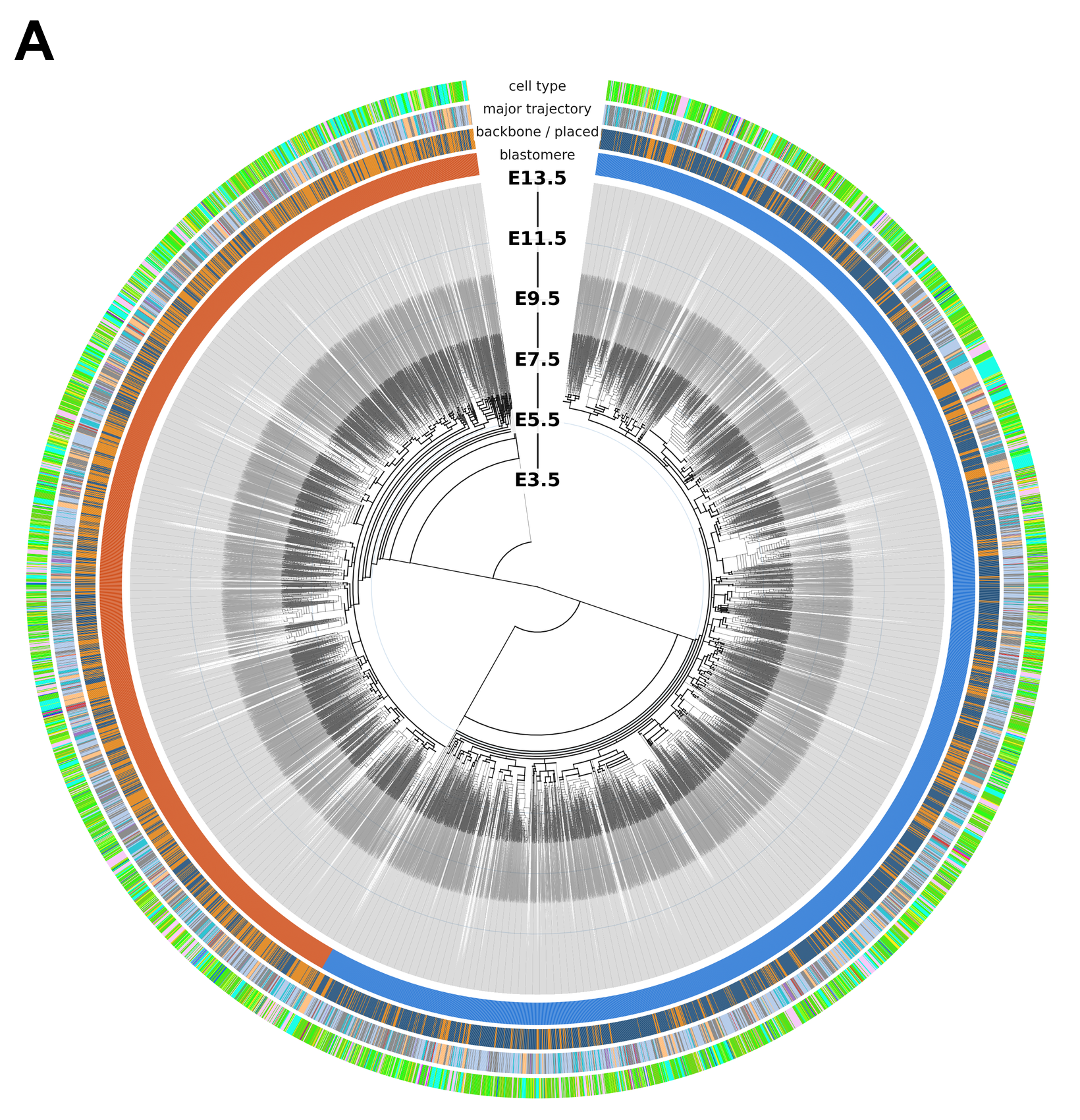
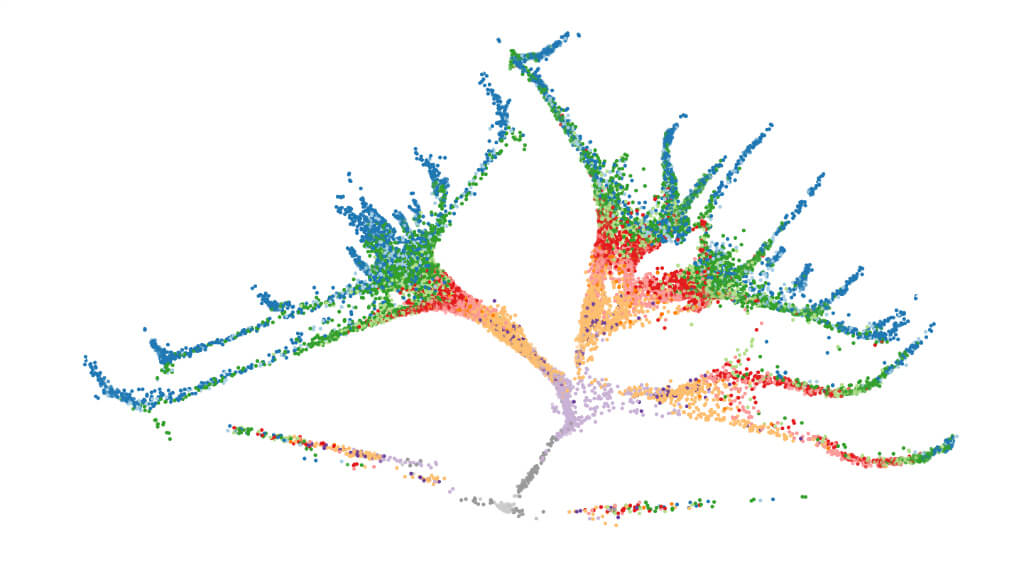
Circular lineage tree of a 13-day old mouse embryo originating from a single cell at the center expanding outward over developmental time. Cells derived from the first cell division are marked in blue or red (credit: Seattle Hub for Synthetic Biology)

“This work brings us closer to understanding one of biology’s fundamental questions on how a single cell gives rise to the extraordinary complexity of a living organism,” said Garabet Yeretssian, director of extramural research and partnerships at Biohub, which has provided ongoing funding for the Seattle Hub. “We are proud to support the Seattle Hub team in developing technologies that make it possible to trace that process at an unprecedented scale and open new ways to understand

how it works/ a journal within the genome

DNA Typewriter works by inserting sequential genetic stamps into a cell’s DNA as it divides. The stamps are copied into every daughter cell—a cell that results when a parent cell divides—and written in order, so they act like a journal within the genome, revealing how a cell divided and what happened to it when it did. Researchers injected the DNA Typewriter system into a fertilized mouse egg and let the embryo develop for 13.5 days, around two-thirds of the way through mouse gestation. They measured the genetic stamps in 1.58 million individual cell nuclei and reconstructed the “family tree” of cells composing the embryo.  

"We were surprised by just how robustly marking happened right at the very first division," said Haedong Kim, co-first author of the study. "It gave us two naturally occurring, independent copies of the same experiment, within a single embryo, so we could check every finding twice."
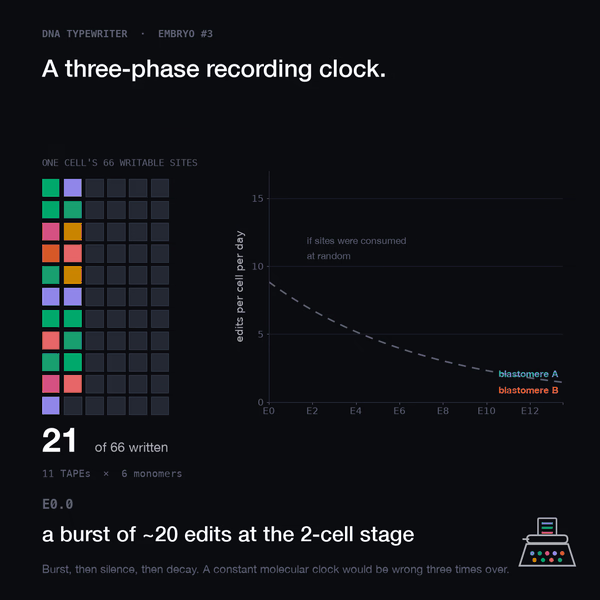
GIF illustrates DNA Typewriter’s recorder, with bursts of edits over the 13.5-day period (credit: Seattle Hub for Synthetic Biology)

what this means for human health/

This research is a critical first step because learning how cells divide and organize during development could help researchers better understand birth defects, cancer, and developmental disorders. By understanding the path of normal cellular development and how one cell becomes many, researchers have a reference model for comparison that can better identify when and where the normal path diverges into disease. This knowledge can help researchers develop ways to prevent abnormal cellular development or intervene when cells go astray.

The DNA Typewriter technology could also be applied to determine how cancer cells spread, better understand how stem cell therapies work, and how aging affects cells in various organs. Recovering biological answers from lineage data could accelerate research that might otherwise take much longer.

Importantly, this study shows that it’s possible to record and read a dense cell lineage history of a complex mammal in a single experiment. The DNA Typewriter system embedded ordered molecular marks throughout mouse development that could be decoded to reconstruct which cell gave rise to which. The resulting tree is publicly available, along with an interactive browser called NextCell that allows anyone to explore this cellular family tree of mouse development.

Citations
No items found.

about the allen institute

Allen Institute is a 501(c)(3) tax exempt organization dedicated to accelerating science for a healthier world. Through large-scale, multidisciplinary research initiatives, the Institute generates foundational knowledge, data, tools, and models that are shared openly with the world to advance our understanding of life and health. Founded by Jody Allen and the late Paul G. Allen, Allen Institute is supported primarily by Fund for Science and Technology.
related news

all news
news
BioCentury Grand Rounds conference highlights importance of big data
The conference hosted Nobel Laureates, researchers, and biotech leaders in Seattle looking to advance better treatments in medicine
news
Seattle Hub for Synthetic Biology launched by Allen Institute, Chan Zuckerberg Initiative, and the University of Washington will turn cells into recording devices to unlock secrets of disease
First-of-its-kind research initiative will develop technologies to reveal how changes in cells and genes over time influence human health and...
science images
SciShots: a cell’s fate
Synthetic biology is helping scientists understand development
news
A computational challenge to help developmental biology
Q&A with the scientists and organizers behind a new competition to use machine learning to reconstruct an entire animal’s developmental lineage
we acceleratedevelopcatalyzeimpact

science done differently. shared openly.

explore our accelerators

brain science

Mapping every cell, connection, and circuit in the brain—openly shared with the world.

cell science

Decoding how cells become tissues, then programming that knowledge into powerful new research tools.

neural dynamics

Revealing the brain's hidden algorithms that transform neural activity into real-world behavior.

immunology

Creating the deepest open reference for the healthy human immune system ever built.

synthetic biology

Engineering cells to record their own histories, transforming how we understand disease over time.

ai biodesign

Advancing evolution to explore biology’s full design space and advance human health

Brain Health

Accelerating human brain research and new therapeutic strategies for neurological conditions

research

Big questions, open answers, and science built to be shared.

education

Inspiring the next generation of scientists through open science resources.

impact

Our science is empowering researchers and advancing health worldwide.
advancing science through open, collaborative research
Get the allen institute newsletter
Stay informed on the latest breakthroughs in neuroscience, bioscience, and AI-driven research.
allen institute
impactpeople & teamscareers & opportunitiesalumnihistory & founder
science resources
allencell.orgallenimmunology.orgallenneuraldynamics.orgbrain-bican.orgbrain-map.orgmicrons-explorer.org
research
brain sciencecell scienceneural dynamicsimmunologysynthetic biologyai biodesignbrain healthpublicationsscience resources
quick links
newseventsopen sciencepodcasthuman brain donationvisit uscontact
education
science educationfield tripsprofessional developmenteducation resources
follow us/

allen institute, 615 Westlake Ave North, Seattle, WA 98109 +12065487055

© 0000 allen institute. all rights reserved.
privacy policyterms of usecitation policyemployee portalpolicy & compliancecookie settings