impact
about
our story
explore our impact
careers and opportunities
join us
open science
sharing science to speed discovery
open science week
celebrating open science
team science
people & teams
discovery is a team effort
allenites
the people who make our work possible
advisors
their input shapes our science
board of directors
they help us fulfill our mission
shanahan foundation fellowship
at the interface of data and neuroscience
next generation leaders
fostering emerging leaders in bioscience
research
overview
our approach
science at the scale of greatest impact
publications
explore our publications
open science
sharing science to speed discovery
science accelerators
brain science
building a blueprint of the brain
cell science
understanding how cells become organs
neural dynamics
revealing the brain’s hidden algorithms
immunology
creating the ultimate immune system reference
synthetic biology
seattle hub for synthetic biology
education
overview
science education
science is for everyone
open science
sharing science speeds discovery
engagement
education resources
real science. real skills.
field trips
experience science where it happens
educator development
empowering educators
news
overview
all news
explore the latest news
podcast
the human stories behind discovery
sign up for our newsletter
stay connected to our science
events
overview
all events
public engagement, workshops, seminars and more
conferences
connect with us
science resources
science resources
allencell.org
allenimmunology.org
allenneuraldynamics.org
brain-bican.org
brain-map.org
microns-explorer.org
impact
back to menu
team science
our story
explore our impact
careers and opportunities
join us
open science
sharing science to speed discovery
open science week
celebrating open science
team science
people & teams
discovery is a team effort
allenites
the people who make our work possible
advisors
their input shapes our science
board of directors
they help us fulfill our mission
shanahan foundation fellowship
at the interface of data and neuroscience
next generation leaders
fostering emerging leaders in bioscience
research
back to menu
overview
our approach
science at the scale of greatest impact
publications
explore our publications
open science
sharing science to speed discovery
science accelerators
brain science
building a blueprint of the brain
cell science
understanding how cells become organs
neural dynamics
revealing the brain’s hidden algorithms
immunology
creating the ultimate immune system reference
synthetic biology
seattle hub for synthetic biology
education
back to menu
overview
science education
science is for everyone
open science
sharing science speeds discovery
engagement
education resources
real science. real skills.
field trips
experience science where it happens
educator development
empowering educators
news
back to menu
overview
all news
explore the latest news
podcast
the human stories behind discovery
newsletter
stay connected to our science
events
back to menu
overview
all events
public engagement, workshops, seminars and more
conferences
connect with us
science resources
back to menu
science resources
allencell.org
allenimmunology.org
allenneuraldynamics.org
brain-bican.org
brain-map.org
microns-explorer.org
search
impact
people

Stefan Mihalas

Investigator, D3 Scientific

teams /
Allenite

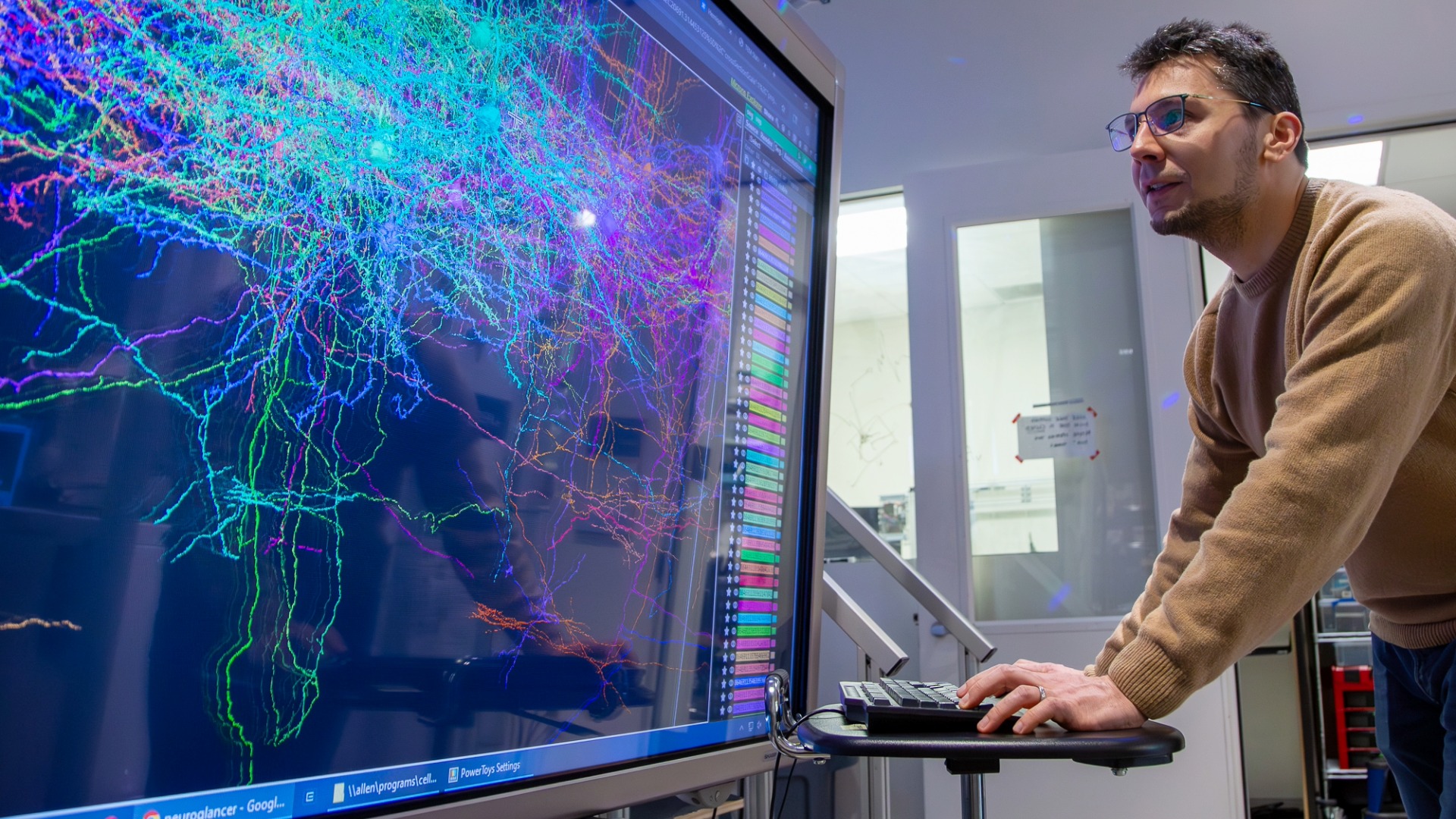
Stefan Mihalas joined the Allen Institute in 2011 from Johns Hopkins University, where he was a postdoctoral fellow in neuroscience and subsequently an associate research scientist. As a computational neuroscientist, Mihalas has worked on models of both molecular and systems neuroscience including nervous system development, synaptic plasticity, minimalistic spiking neuron models, self-organized criticality, visual attention and figure ground segregation. His current research interests are aimed at building models to elucidate how large networks of interacting neurons produce cognitive behaviors. At the Allen Institute, Mihalas integrates anatomical and physiological connectivity data to generate models of visual perception in the mouse. To this end, he works to build a series of models of increasing complexity for both individual components, i.e., neurons, synapses, and microcircuits, as well as for large portions of the entire system. This series of models will be compared to the simplified theoretical predictions from statistical physics, information theory and computer vision. Mihalas received his Diploma in physics and M.S. in mathematics from West University of Timisoara in Romania. He received his Ph.D. in physics from the California Institute of Technology.

back to people and teams
featured contributions
featured media
featured stories
featured events
featured publications

featured events

No articles for the category

featured stories

No articles for the category

featured media

No articles for the category

featured publications

publication / 2025
Integrating multimodal data to understand cortical circuit architecture and function
Nature Neuroscience
publication / 2024
Simple synaptic modulations implement diverse novelty computations
Cell Reports
publication / 2024
Backward masking in mice requires visual cortex
Nature Neuroscience
publication / 2023
Gaussian Partial Information Decomposition: Bias Correction and Application to High-dimensional Data
Advances in Neural Information Processing Systems
publication / 2023
A biologically inspired architecture with switching units can learn to generalize across backgrounds
Neural Networks: The Official Journal of the International Neural Network Society
publication / 2023
Neural population dynamics of computing with synaptic modulations
eLife
preprint / 2023
Stimulus novelty uncovers coding diversity in visual cortical circuits
publication / 2023
Heterogeneity in Neuronal Dynamics Is Learned by Gradient Descent for Temporal Processing Tasks
Neural Computation
publication / 2023
A whole-brain monosynaptic input connectome to neuron classes in mouse visual cortex
Nature Neuroscience
publication / 2023
Modeling the cell-type-specific mesoscale murine connectome with anterograde tracing experiments
Network Neuroscience (Cambridge, Mass.)
publication / 2022
Mesolimbic dopamine release conveys causal associations
Science (New York, N.Y.)
publication / 2022
The geometry of representational drift in natural and artificial neural networks
PLoS computational biology
publication / 2022
MouseNet: A biologically constrained convolutional neural network model for the mouse visual cortex
PLoS computational biology
publication / 2022
Single Circuit in V1 Capable of Switching Contexts During Movement Using an Inhibitory Population as a Switch
Neural Computation
publication / 2021
Cell-type-specific neuromodulation guides synaptic credit assignment in a spiking neural network
Proceedings of the National Academy of Sciences of the United States of America
publication / 2021
Adaptation supports short-term memory in a visual change detection task
PLoS computational biology
publication / 2021
Autoencoder networks extract latent variables and encode these variables in their connectomes
Neural Networks: The Official Journal of the International Neural Network Society
publication / 2021
Survey of spiking in the mouse visual system reveals functional hierarchy
Nature
publication / 2021
Regional, Layer, and Cell-Type-Specific Connectivity of the Mouse Default Mode Network
Neuron
publication / 2021
A Multisubcellular Compartment Model of AMPA Receptor Trafficking for Neuromodulation of Hebbian Synaptic Plasticity
Frontiers in Synaptic Neuroscience
publication / 2020
Brain Modeling ToolKit: An open source software suite for multiscale modeling of brain circuits
PLoS computational biology
publication / 2020
Systematic Integration of Structural and Functional Data into Multi-scale Models of Mouse Primary Visual Cortex
Neuron
publication / 2020
Experience shapes activity dynamics and stimulus coding of VIP inhibitory cells
eLife
publication / 2020
Characterization of Learning, Motivation, and Visual Perception in Five Transgenic Mouse Lines Expressing GCaMP in Distinct Cell Populations
Frontiers in Behavioral Neuroscience
publication / 2020
A large-scale standardized physiological survey reveals functional organization of the mouse visual cortex
Nature Neuroscience
publication / 2020
Contextual Integration in Cortical and Convolutional Neural Networks
Frontiers in Computational Neuroscience
publication / 2019
Hierarchical organization of cortical and thalamic connectivity
Nature
publication / 2019
Classification of electrophysiological and morphological neuron types in the mouse visual cortex
Nature Neuroscience
publication / 2019
Single-cell activity tracking reveals that orbitofrontal neurons acquire and maintain a long-term memory to guide behavioral adaptation
Nature Neuroscience
publication / 2019
Synchronization dependent on spatial structures of a mesoscopic whole-brain network
PLoS computational biology
publication / 2019
High-resolution data-driven model of the mouse connectome
Network Neuroscience (Cambridge, Mass.)
publication / 2018
Visual physiology of the layer 4 cortical circuit in silico
PLoS computational biology
publication / 2018
Sparse recurrent excitatory connectivity in the microcircuit of the adult mouse and human cortex
eLife
publication / 2018
Generalized leaky integrate-and-fire models classify multiple neuron types
Nature Communications
publication / 2017
Visual processing mode switching regulated by VIP cells
Scientific Reports
publication / 2017
Experience-dependent homeostasis of 'noise' at inhibitory synapses preserves information coding in adult visual cortex
Philosophical Transactions of the Royal Society of London. Series B, Biological Sciences
publication / 2017
A Computational Analysis of the Function of Three Inhibitory Cell Types in Contextual Visual Processing
Frontiers in Computational Neuroscience
publication / 2016
A Comparison of Visual Response Properties in the Lateral Geniculate Nucleus and Primary Visual Cortex of Awake and Anesthetized Mice
The Journal of Neuroscience: The Official Journal of the Society for Neuroscience
publication / 2016
The Computational Properties of a Simplified Cortical Column Model
PLoS computational biology
publication / 2016
Inferring cortical function in the mouse visual system through large-scale systems neuroscience
Proceedings of the National Academy of Sciences of the United States of America
publication / 2016
Effects of Chronic Sleep Restriction during Early Adolescence on the Adult Pattern of Connectivity of Mouse Secondary Motor Cortex
eNeuro
publication / 2016
Analytical Calculation of Errors in Time and Value Perception Due to a Subjective Time Accumulator: A Mechanistic Model and the Generation of Weber's Law
Neural Computation
publication / 2015
Canonical genetic signatures of the adult human brain
Nature Neuroscience
publication / 2014
Large-scale topology and the default mode network in the mouse connectome
Proceedings of the National Academy of Sciences of the United States of America
publication / 2014
Local spectral anisotropy is a valid cue for figure-ground organization in natural scenes
Vision Research
publication / 2014
A mesoscale connectome of the mouse brain
Nature
publication / 2014
A temporal basis for Weber's law in value perception
Frontiers in Integrative Neuroscience
publication / 2014
A general theory of intertemporal decision-making and the perception of time
Frontiers in Behavioral Neuroscience
publication / 2013
The influence of synaptic weight distribution on neuronal population dynamics
PLoS computational biology
publication / 2013
Locally Contractive Dynamics in Generalized Integrate-and-Fire Neurons
SIAM journal on applied dynamical systems
we acceleratedevelopcatalyzeimpact

science done differently. shared with the world.

explore our accelerators

brain science

Mapping every cell, connection, and circuit in the brain—openly shared with the world.

cell science

Decoding how cells become tissues, then programming that knowledge into powerful new research tools.

neural dynamics

Revealing the brain's hidden algorithms that transform neural activity into real-world behavior.

immunology

Creating the deepest open reference for the healthy human immune system ever built.

synthetic biology

Engineering cells to record their own histories, transforming how we understand disease over time.

research

Big questions, open answers, and science built to be shared.

education

Inspiring the next generation of scientists through open science resources.

impact

Our science is empowering researchers and advancing health worldwide.
advancing science through open, collaborative research
Get the allen institute newsletter
Stay informed on the latest breakthroughs in neuroscience, bioscience, and AI-driven research.
allen institute
impactpeople & teamscareers & opportunitiesalumnihistory & founder
science resources
allencell.orgallenimmunology.orgallenneuraldynamics.orgbrain-bican.orgbrain-map.orgmicrons-explorer.org
research
brain sciencecell scienceneural dynamicsimmunologysynthetic biologypublications
education
science educationfield tripsprofessional developmenteducation resources
quick links
newseventsopen sciencepodcastscience resourceshuman brain donationvisit uscontact
follow us/

allen institute, 615 Westlake Ave North, Seattle, WA 98109 +12065487055

© 0000 allen institute. all rights reserved.
privacy policyterms of usecitation policyemployee portalpolicy & compliancecookie settings