
Different regions of our brains process information at different speeds. Some walk, others jog, while others can sprint when processing data from the world around us and when we think and reason. This baseline speed also determines how long it takes for that brain region to process information—something called the intrinsic neural timescale, or INT. Some are long; others are short. But they all work together like a finely tuned orchestra to give humans our exceptional brain power.
Researchers at Rutgers Health and Cornell University created a powerful computer model that was able to predict the “processing speeds” (INTs) of these various brain regions from connectivity data—data that reveals the labyrinth-like connection patterns of billions of brain cells that branch out and form networks. They discovered that brain regions can change how fast they process information in order to tackle complex cognitive tasks—some can start running while others can slow down—and the effort required to make these state transitions correlated with certain aspects of cognition; namely, the less effort needed to make a state transition was linked to higher performance in cognitive tasks.
“People whose brain wiring is better matched to the way different regions handle fast and slow information tend to show higher cognitive capacity,” said Linden Parkes, Ph.D., assistant professor of psychiatry at Rutgers Robert Wood Johnson Medical School and senior author of a recent study in Nature Communications that presented the findings.
Researchers looked specifically at the brain’s ability to:
-
- abstractly reason and recognize patterns;
- mentally visualize three-dimensional space and position; and
- perform list sorting, the ability to remember and reorganize list items based on their qualities.
“Brain regions both tune their INTs and talk to each other in complex ways to make these state transitions happen when performing tasks. Our model takes a data-driven approach by listening carefully to how each region is changing its speed in the context of the whole conversation,” said Jason Z. Kim, Ph.D., a Schmidt AI in Science postdoctoral fellow at Cornell University and lead author of the study.
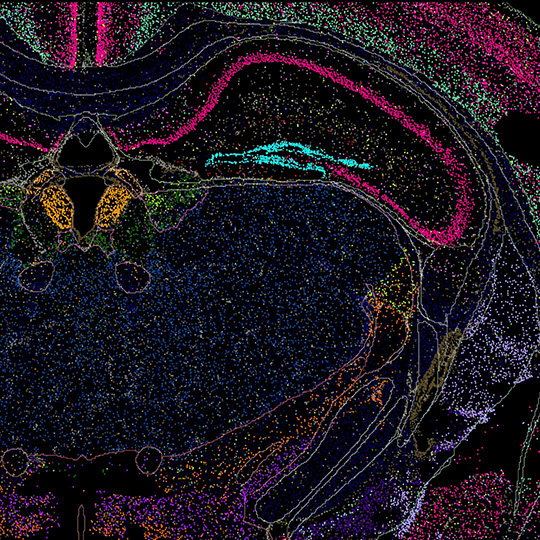
Researchers used the openly available Allen Human Brain Atlas to validate the accuracy of their model and provide a neurobiological foundation for its predictions. The Atlas reveals gene expression data based on specific brain regions, in other words, what RNA molecules these regions produce. They compared these data with their own, which reflected connectivity and INT data for those same regions. Overlaying those two datasets allowed them to look for regional patterns between gene expression, connectivity, and brain processing speed (INTs). These three measures synced up.
I've been using the Allen Institute resources in various projects for the better part of ten years since the start of my Ph.D. It's been transformative to my research.
Linden Parkes, Ph.D., Assistant Professor of Psychiatry at Rutgers Robert Wood Johnson Medical School

“Working with the Allen Institute data helps us ground our analysis in neurobiology, which is super important to us because otherwise we’re just computational scientists playing with models. It’s really helpful for us to say, ‘well, okay, do the outputs of the mathematical models that we build and tinker with link to the neurobiological foundations of the brain,’ which is where the Allen Institute data is super powerful.”
Researchers also found the same patterns in both human and mouse brains, suggesting it is a basic evolutionary feature of how brains are built. This important foundational understanding of neural dynamics advances our understanding of the brain’s adaptability.
“Our work sheds light on the complex relationship between the brain’s intricate connectivity and the spatial pattern of cortical INTs. We uncover how the brain can leverage its connectivity to reorganize INTs across the cortex in response to cognitively relevant brain states,” said Parkes. “This shifts our understanding of INTs from a static property to a flexible and adaptive one and shows that we can capture this flexibility in a data-driven way.”
Citations
about the allen institute
Allen Institute is a 501(c)(3) tax exempt organization dedicated to accelerating science for a healthier world. Through large-scale, multidisciplinary research initiatives, the Institute generates foundational knowledge, data, tools, and models that are shared openly with the world to advance our understanding of life and health. Founded by Jody Allen and the late Paul G. Allen, Allen Institute is supported primarily by Fund for Science and Technology.
.gif)

.avif)