impact
about
our story
explore our impact
careers and opportunities
join us
open science
sharing science to speed discovery
open science week
celebrating open science
team science
people & teams
discovery is a team effort
advisors
their input shapes our science
board of directors
they help us fulfill our mission
shanahan foundation fellowship
at the interface of data and neuroscience
studio d3 fellowship
contribute bold ideas to redefine discovery
next generation leaders
fostering emerging leaders in bioscience
research
overview
our approach
science at the scale of greatest impact
additional programs
studio d3
data driven discovery
neurobiology of action
revealing the mechanisms behind movement and learning
science accelerators
brain science
building a blueprint of the brain
cell science
understanding how cells become organs
neural dynamics
revealing the brain’s hidden algorithms
immunology
mapping the immune system
synthetic biology
designing biology to advance health
brain health
accelerating human brain research
ai biodesign
unlocking new frontiers of bioscience
education
overview
science education
science is for everyone
open science
sharing science speeds discovery
engagement
education resources
real science. real skills.
field trips
experience science where it happens
educator development
empowering educators
news
overview
all news
explore the latest news
podcast
the human stories behind discovery
sign up for our newsletter
stay connected to our science
events
overview
all events
public engagement, workshops, seminars and more
conferences
connect with us
science resources
explore
publications
explore our publications
open science
sharing science to speed discovery
science resources
allencell.org
allenimmunology.org
allenneuraldynamics.org
brain-bican.org
brain-map.org
microns-explorer.org
impact
back to menu
overview
our story
explore our impact
careers and opportunities
join us
open science
sharing science to speed discovery
open science week
celebrating open science
team science
people & teams
discovery is a team effort
advisors
their input shapes our science
board of directors
they help us fulfill our mission
shanahan foundation fellowship
at the interface of data and neuroscience
studio d3 fellowship
contributing bold ideas to redefine discovery
next generation leaders
fostering emerging leaders in bioscience
research
back to menu
overview
our approach
science at the scale of greatest impact
publications
explore our publications
open science
sharing science to speed discovery
science accelerators
brain science
building a blueprint of the brain
cell science
understanding how cells become organs
neural dynamics
revealing the brain’s hidden algorithms
immunology
creating the ultimate immune system reference
synthetic biology
seattle hub for synthetic biology
brain health
accelerating human brain research and disease therapeutics
ai biodesign
unlocking new frontiers of bioscience
additional programs
studio d3
data driven discovery
neurobiology of action
revealing the mechanisms behind movement and learning
education
back to menu
overview
science education
science is for everyone
open science
sharing science speeds discovery
engagement
education resources
real science. real skills.
field trips
experience science where it happens
educator development
empowering educators
news
back to menu
overview
all news
explore the latest news
podcast
the human stories behind discovery
newsletter
stay connected to our science
events
back to menu
overview
all events
public engagement, workshops, seminars and more
conferences
connect with us
science resources
back to menu
science resources
allencell.org
allenimmunology.org
allenneuraldynamics.org
brain-bican.org
brain-map.org
microns-explorer.org
explore
publications
explore our publications
open science
sharing science to speed discovery
search
events
Stem Cell & Developmental Biology Early Career Symposium

attendee details

This is some text inside of a div block.
Thank you! Your submission has been received!
Oops! Something went wrong while submitting the form.

Attending the symposium? You should have received a password to access this attendee details page. Please reach out to events@alleninstitute.org if you have difficulty accessing this page.

location / Allen Institute
dates / September 23 - 25, 2026

attendee information

venue details/

  • The conference will be held at the Allen Institute in Seattle, WA. Please visit Getting to the Institute for more information on building access.  
  • Check-in will start each day in the lobby (please refer to the final agenda for the time, as it may vary). You will be granted a badge that must be worn during the entirety of your visit to the Allen Institute.  
  • Sessions will take place in the Auditorium, with meals and posters taking place in the Atrium, all located on the first and second floor of the of the institute.

networking social/

Science in the City & Allen Institute

As a participant in the Early Career Stem Cell & Developmental Biology Symposium, you receive free admission to the co-hosted Allen Institute/Science in the City Networking event!

Join fellow early-career scientists and members of Seattle’s life science community for an afternoon of networking, conversation, and fun. The event is co-hosted by Science in the City and the Allen Institute and will feature game-based networking, light appetizers, science-themed prizes, and two beer or wine tickets.

When: September 25, 2026 | 4:00–6:00 p.m.
Where: Dexter Yard North building | 700 Dexter Ave N, Seattle, WA 98109
Cost: Free for symposium attendees

Registration is required so we can track attendance and reserve your spot. Please register for the networking event using the registration link below.

register here

discount code: ScienceConnect615

‍

podcast recording and networking session/

  • The live recording of the Stem Cell Podcast will take place in the Auditorium at the end of day 2, September 24th
  • The Science in Seattle networking session will take place at Dexter Yard, only a 6-minute walk away, located at 700 Dexter Avenue North, Seattle, WA 98109, at the end of Day 3, September 25th

workshop preview/

Findable, Not Famous: Low-Effort Social Media for Busy Researchers

Wednesday, September 23rd 9:00-10:00am

Gatekeepers are using search and social media to discover early career researchers for opportunities. Can they find you and what will they find? This session will show you how to make your work more findable and compelling without becoming a full-time content creator. This workshop is perfect for social media novices, power users who are looking for inspiration, and everyone in between.

Beyond the Coating: Decoding the Right Laminin for Cell Fate

Wednesday, September 23rd 10:00-11:00am

Sponsored by BioLamina

Have you ever wondered whether your cells are thriving because of the ECM coating you’ve selected, or simply surviving in spite of it? In this interactive, data-driven workshop, we’ll take a look behind the final culture protocol to examine how researchers have used cross-functional methods from developmental genetics, spatial biology, protein chemistry, and cell physiology to select full-length laminin isoforms for maintaining cell identity and directing differentiation. Contrasting case studies, audience polls, and lively discussion will help us challenge the evidence, reconsider assumptions, and decide what the data truly justify at each experimental stage. Together, we will explore why chain expression does not automatically prove physiological influence, why attachment is not the same as support, and why the natural biology of cell fate is key to this understanding. Come prepared to vote, debate, change your mind, and leave with a sharper framework for choosing the right laminin for the right cell state.

Optimized 2D Culture Workflows Support Long-Term Genetic Stability in hPSCs

Wednesday, September 23rd 11:00-12:00pm

Sponsored by STEMCELL Technologies

Efforts to enhance rigor and reproducibility of human pluripotent stem cell (hPSC) research have driven the development of defined quality standards and guidelines. Genomic status is an important quality attribute of hPSC cultures, as prolonged culture can lead to cytogenetic changes associated with increased expansion and altered differentiation capability, thus compromising data reliability and reproducibility. Previous meta-analyses report genetic abnormality rates of ~22; however, these studies often lack traceable metadata on starting genomic status and culture conditions.

We evaluated genetic stability in two studies using standardized 2D aggregate- and single-cell-based workflows. In the first study, a longitudinal analysis of more than 100 independent cultures initiated from hPSC lines characterized in alignment with the International Society for Stem Cell Research (ISSCR) Standards for Human Stem Cell Use in Research showed an abnormality rate of only 2.9% with aggregate-based passaging and routine genetic assessment.

In the second study, an automated hPSC culture workflow was used to independently maintain 271 clonal sublines derived from three hPSC lines for 20 weeks using single-cell passaging. SNP microarray analysis showed that 70% of sublines maintained in two control media acquired at least one de novo abnormality, compared with 25% maintained in eTeSR™, a medium optimized for single-cell passaging. Small structural variants were detected in 69% of control cultures versus 3% with eTeSR™, while the recurrent chromosome 20q11 gain was detected in 51% of control sublines and in none of the eTeSR™ cultures.

These studies show that well-characterized cell banks, standardized and automated culture workflows, rigorous quality practices, and media optimized for the intended passaging method can reduce culture-acquired genetic abnormalities in hPSCs.

The Early Career Researcher’s Guide to Navigating the Funding Landscape

Friday, September 25th 9:00-10:00am

Securing independent funding is a crucial milestone for early career researchers (ECRs). However, navigating the research funding landscape is one of the greatest challenges we face. This workshop is designed to tackle this challenge by providing practical and actionable guidance on both US-based and international funding mechanisms.

We have assembled a fantastic panel of speakers with expertise in a broad range of ECR funding opportunities. They will cover many critical topics, including strategies for identifying funding opportunities, navigating the grant application process, international and collaborative funding mechanisms, and connecting with key people and resources to help you succeed.  Attendees will also have the unique opportunity to engage directly with our speakers during a dedicated Q&A session. We encourage you to come prepared with all your burning funding questions!  

Whether you are a graduate student, postdoc, or early-career faculty, this workshop will be a great resource!

hotel & travel

hotel arrangements

*Guests are responsible for arranging their own air travel and hotel room.

**Travel Award evaluations are ongoing, and applicants will be notified as soon as decisions are finalized.

Allen Institute has arranged discounted rates from the following nearby hotels, all within a 0.5 radius of the institute:  ‍

  • Level Hotel SLU (click Book Now and enter promo code”Allen”)
    • Event speakers will be staying here! ‍
  • Mayflower Park‍
  • Paramount Hotel‍
  • Courtyard by Marriott Seattle Downtown/Lake Union

NOTE: the links above take you to discounted rates arranged by Allen Institute. You may need to select dates first before the discounted rates appear.

air travel

  • Alaska Airlines discount code: ECMQ244
  • Travelers to the conference can book theirflights conveniently online at AlaskaAir.com by entering the Discount Code whensearching for flights. The system will automatically apply the discount to anyflights that meet the contract requirements.
  • If you prefer to make your reservation by phone,they can call the Alaska Airlines Group Desk. Please note that a $15.00 perperson service fee will apply for bookings made over the phone.
  • Guests are responsible for arranging their ownair travel and hotel room.

Travel Award evaluations are ongoing, and applicants will benotified as soon as decisions are finalized.

dependent care stipend

  • The Allen Institute’s Dependent Care Stipend program aims to reduce barriers to event attendance. As an invited attendee to this meeting, you are eligible to apply for a dependent care stipend. ‍
  • Learn more here.  ‍
  • Apply for support here.

poster presentations 

Poster sessions will take place after talks conclude on Wednesday September 23, from 4:20 – 6:20 pm, and Thursday September 24, from 3:30 – 4:30 pm. Presenters are assigned a presentation day, announced in late August.

acceptance letter

Attendees who need an acceptance letter can generate one via this fillable Acceptance Letter PDF.

guests 

Registration applies to the invited attendee only. No guests or spouses are allowed at the Conference or Podcast recording. 

Please contact events@alleninstitute.org with any questions. We look forward to hosting you!

event sponsors

Thank you to our Sponsors!
‍

event home
agenda
speakers
hotel & travel
sponsors
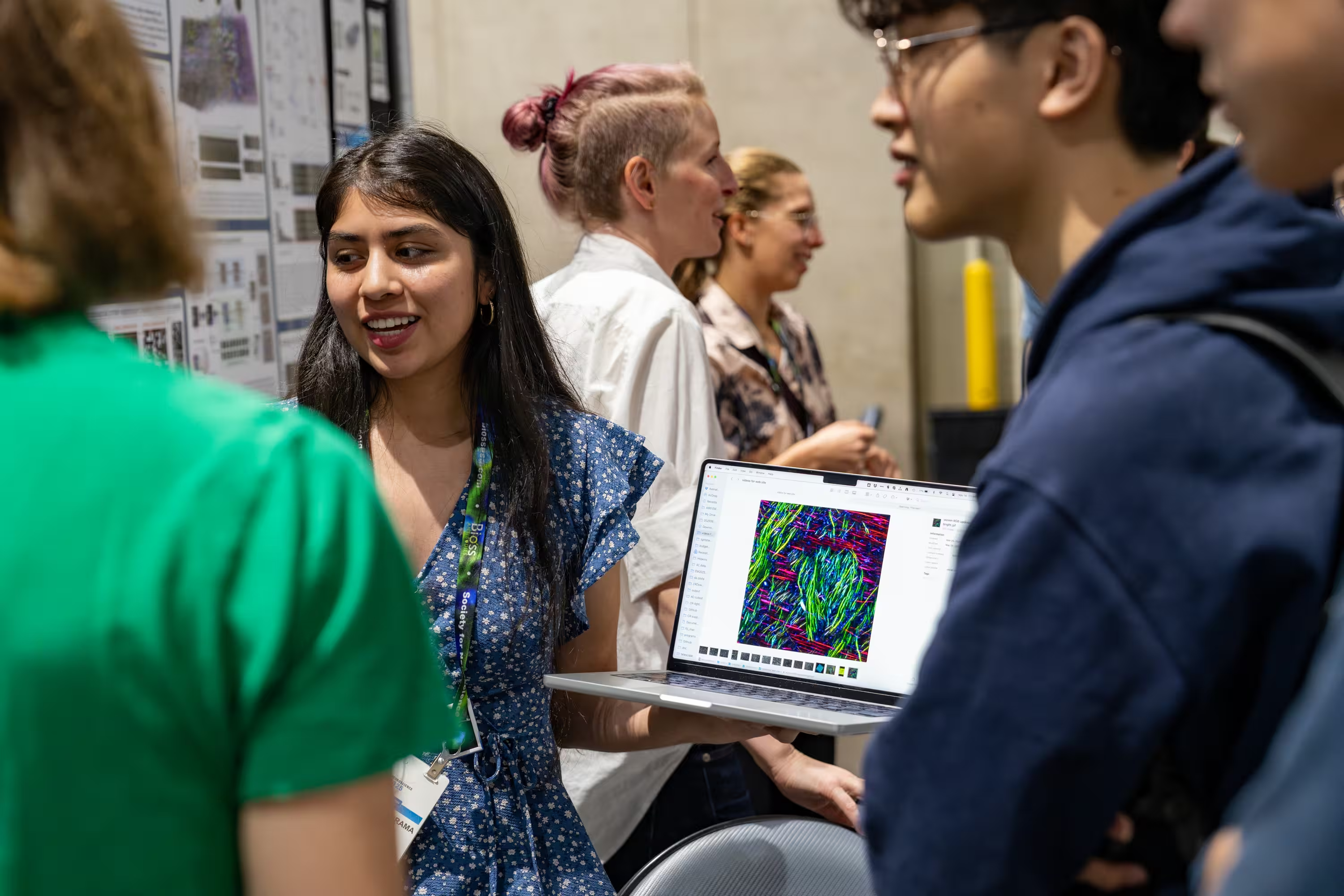
Scientists present colorful microscopy research data on laptop at academic conference poster session

safety, respect, inclusion: our event code of conduct

learn more
we acceleratedevelopcatalyzeimpact

science done differently. shared openly.

explore our accelerators

brain science

Mapping every cell, connection, and circuit in the brain—openly shared with the world.

cell science

Decoding how cells become tissues, then programming that knowledge into powerful new research tools.

neural dynamics

Revealing the brain's hidden algorithms that transform neural activity into real-world behavior.

immunology

Creating the deepest open reference for the healthy human immune system ever built.

synthetic biology

Engineering cells to record their own histories, transforming how we understand disease over time.

ai biodesign

Advancing evolution to explore biology’s full design space and advance human health

Brain Health

Accelerating human brain research and new therapeutic strategies for neurological conditions

research

Big questions, open answers, and science built to be shared.

education

Inspiring the next generation of scientists through open science resources.

impact

Our science is empowering researchers and advancing health worldwide.
advancing science through open, collaborative research
Get the allen institute newsletter
Stay informed on the latest breakthroughs in neuroscience, bioscience, and AI-driven research.
allen institute
impactpeople & teamscareers & opportunitiesalumnihistory & founder
science resources
allencell.orgallenimmunology.orgallenneuraldynamics.orgbrain-bican.orgbrain-map.orgmicrons-explorer.org
research
brain sciencecell scienceneural dynamicsimmunologysynthetic biologyai biodesignbrain healthpublicationsscience resources
quick links
newseventsopen sciencepodcasthuman brain donationvisit uscontact
education
science educationfield tripsprofessional developmenteducation resources
follow us/

allen institute, 615 Westlake Ave North, Seattle, WA 98109 +12065487055

© 0000 allen institute. all rights reserved.
privacy policyterms of usecitation policyemployee portalpolicy & compliancecookie settings