
Today at their annual general meeting, the National Academy of Medicine announced the election of Hongkui Zeng, Ph.D, Allen Institute’s Executive Vice President and Director of the Allen Institute for Brain Science, to their membership for her leading role in understanding the cell types and the functional architecture of the mammalian brain.
Election to the Academy is considered one of the highest honors in the fields of health and medicine and recognizes leaders who have demonstrated outstanding professional achievement and made lasting contributions to the advancement of the medical sciences, health care, and public health.

“I am thrilled and honored by this prestigious recognition, joining more than 90 others this year across the globe for our collective work in advancing medical science,” said Zeng. “I feel incredibly fortunate and inspired to work alongside so many amazing colleagues at the Allen Institute. This recognition today is a testament to the Institute’s commitment to collaborative science, and it is because of our collective efforts that we can celebrate this honor.”
Zeng is among 90 new members and 10 international members elected to the National Academy of Medicine this year.
“Hongkui embodies the Academy’s mission to ‘improve health for all by advancing science,’” said Rui Costa, D.V.M., Ph.D., President and Chief Executive Officer of the Allen Institute. “Her leadership, vision, and tenacity in pursuing some of the most difficult questions about the brain will have a lasting impact on science and health.”
Zeng joined the Allen Institute in 2006. During the last two decades, she has organized and led multidisciplinary teams to develop and operate high-throughput pipelines to generate large-scale, open-access datasets and tools to accelerate neuroscience discovery, with a focus on characterizing the cell types and circuits in the brain as the foundation for understanding brain function and diseases.

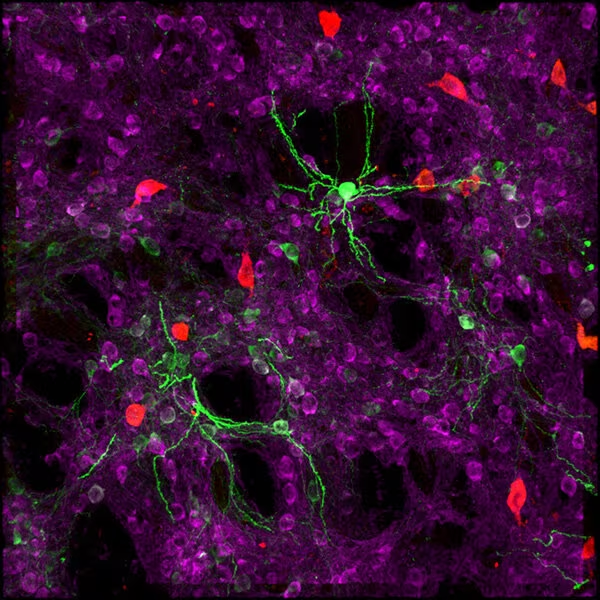
Zeng has led several key research programs including the Transgenic Technology program (gene modification); the Human Cortex Gene Survey project; the Allen Mouse Brain Connectivity Atlas (mapping connections between different regions of the mouse brain), one of the Allen Institute’s most widely downloaded and used open-data resources; and most notably, the Cell Types program to create transcriptomic (gene expression) and multimodal cell type classifications that have been widely regarded as high-quality standards in the field.
Earlier this year, Zeng was also elected to the National Academy of Sciences and received the prestigious Pradel Research Award for her pioneering work in neuroscience.
Citations
about the allen institute
Allen Institute is a 501(c)(3) tax exempt organization dedicated to accelerating science for a healthier world. Through large-scale, multidisciplinary research initiatives, the Institute generates foundational knowledge, data, tools, and models that are shared openly with the world to advance our understanding of life and health. Founded by Jody Allen and the late Paul G. Allen, Allen Institute is supported primarily by Fund for Science and Technology.