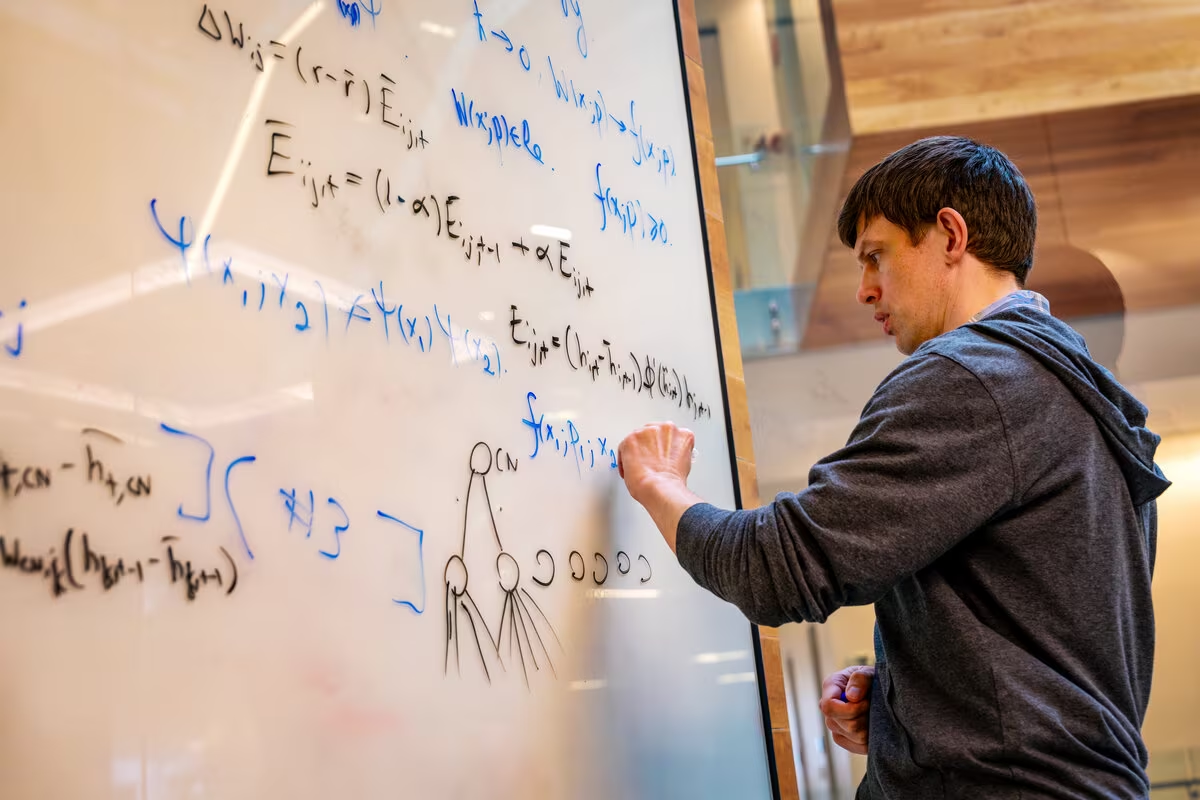

For decades, most scientists believed that re-creating the function of a human brain in the digital world was a myth of science fiction. Our brains have 86 billion neurons, and the scientific community viewed the ability to fully understand – much less mimic – how all of them connect, signal, and change over time to be virtually impossible. But with recent advances in computing power, enhanced microscopy, better neuron-tracing tools, and artificial intelligence, scientists now believe it’s a matter of when, not if, they can emulate a human brain in a computer, though it’s still far off – likely a few decades away. To get us there, researchers are trying to replicate the brain functions of smaller animals with less complex brains. And they’re getting closer.
Scientists from around the world, including one from the Allen Institute, have captured the state of the science and path to progress in a new report revealing a roadmap to accomplishing this incredible feat and the barriers researchers must cross to achieve it. Taking stock of the brain emulation landscape at this scale hasn’t been done in almost 20 years. Achieving the ultimate goal (a human brain) goes beyond simulating brain behavior; scientists aim to recreate the underlying neural system so that the model behaves for the same reasons a real brain does.
“Emulation means I’m replicating the very architecture that gave rise to the behavior in the first place,” said Max Schons, project lead for the report. “In a sense, large language models are brain simulators because they can replicate certain aspects of human behavior, but they don’t use the same architecture as a human brain does to process information.”
technical advances driving the path to progress
Scientists point out three core capabilities required to accurately emulate the brain: the ability to record brain activity; reconstruct brain wiring, or connectomics; and digitally model the brain using data from the first two capabilities. Technological advances in all three areas have led to great strides toward brain emulation:
- Neural recording technologies can now capture anywhere from tens of thousands to millions of neurons simultaneously in small animals, which is about 100 times more than technologies could 25 years ago.
- Connectomics has advanced from the first complete worm brain connectome to a full adult fruit fly brain reconstruction, while the cost to do so has dramatically decreased. The Allen Institute played a leading role in reconstructing a functional wiring diagram of a portion of the mouse visual cortex —something long thought impossible.
- Computational modeling can now simulate entire small nervous systems and simplified mammalian scale brains on modern supercomputers.
“In the last two decades, we’ve had orders of magnitude improvements in understanding gene expression in single cells and their electrical properties,” said Anton Arkhipov, Allen Institute investigator and co-author of the study. “Connectomics and transcriptomics have greatly advanced, so we can record and understand more neurons than we ever could before.”
progress in less complex animals
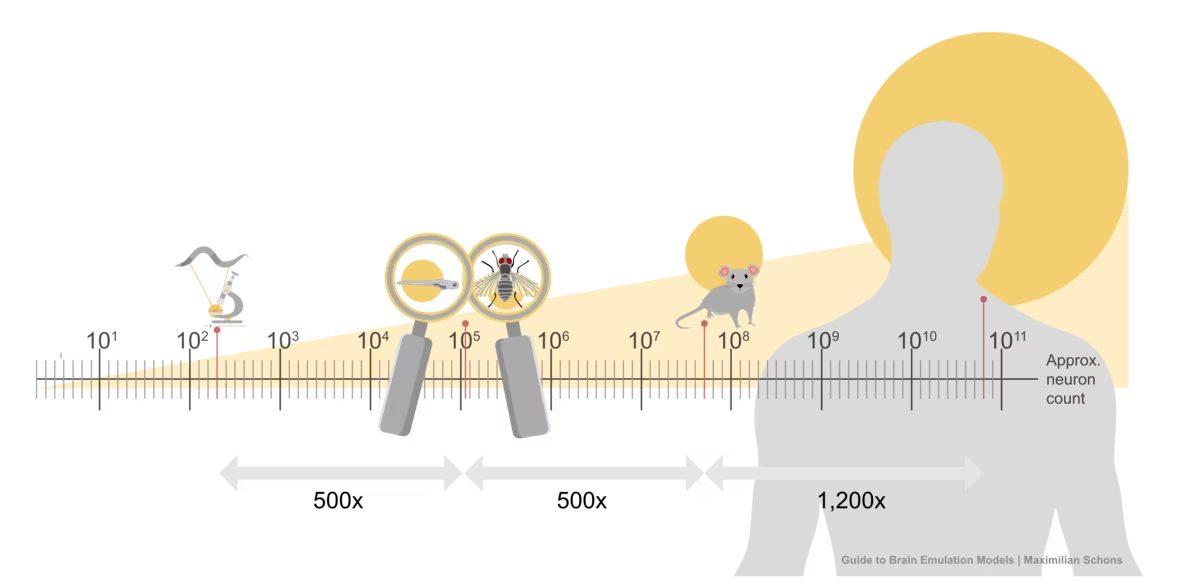
Scientists focused on five increasingly complex organisms to help gauge their progress on brain emulation: worm (C. elegans), larval zebrafish, fruit fly, mouse, and human. Researchers have developed basic brain models encompassing nearly all the neurons in worms and the fruit fly, which has 140 thousand neurons, and scientists estimate a full zebrafish and fruit fly brain emulations could be accomplished in three to eight years. In mice, which have 70 million neurons, scientists have models of certain brain regions, such as 230-thousand neurons of a column in the visual cortex.
It would take much more powerful computational modeling to emulate a human brain and its 86 billion neurons, something on the order of an entire data center focused on just this undertaking, plus an unprecedented financial commitment. But even vastly scaling up computing power could still leave gaps where scientists would need to infer the function of some neurons given their understanding of the overall neuronal structure of the brain – in short, how to predict what neurons do based on how they are connected and what molecules they release, such as neurotransmitters. Scientists must also consider the ethical considerations of emulating a brain and what role AI will play in these efforts.
what human brain simulation would mean for science
The potential benefits of brain emulation are numerous and wide-ranging. Having a digital brain could allow scientists to run countless virtual experiments — rather than relying solely on real brain tissue, which is expensive and hard to get — to surface new insights into brain function. This knowledge could help doctors and scientists better understand brain diseases like Alzheimer’s, ALS, addiction, and neuropsychiatric disorders, and could lead to new and better treatments for these conditions. A fully functioning brain simulation could also allow researchers to test the effectiveness and safety of new drugs, accelerating drug discovery and development by quickly identifying promising drugs to invest in.
Brain emulation may also lead to AI systems that are based on human brain functions, improving AI accuracy and learning efficiency. The brain is also one of the most energy-efficient systems in the world and could serve as a guide to build AI models that leave lighter footprints on the environment through their energy needs.
Despite the promise, scientists still believe human brain emulation is a few decades away. However, they now view it as a viable long-term scientific goal and not just a plot point in Hollywood science fiction.
Citations
about the allen institute
Allen Institute is a 501(c)(3) tax exempt organization dedicated to accelerating science for a healthier world. Through large-scale, multidisciplinary research initiatives, the Institute generates foundational knowledge, data, tools, and models that are shared openly with the world to advance our understanding of life and health. Founded by Jody Allen and the late Paul G. Allen, Allen Institute is supported primarily by Fund for Science and Technology.