music heals mental health
Music has long been understood as a powerful force in shaping how we feel, think, and connect with the world around us. Across cultures, it has served as a tool for expression, comfort and transformation, capable of shifting mood, unlocking memory and reframing our perspective. Today, science is beginning to validate what we’ve intuitively known for centuries: music engages complex systems in the brain, influencing neural pathways and even the cells that define our emotional and mental experiences.
In partnership with KEXP, we’re helping to illuminate the science behind these connections and sharing more about the research that’s advancing this field. If you missed it on the radio or just want to dig into the data, below we’ve compiled the stories and articles that we shared on May 28 that explored how music and science intersect in amazing ways.

moments of learning
music is a time machine
listen/
You know how a random song can drop you into a moment from years ago? There’s a name for that: music-evoked autobiographical memory. Scientists say music links emotion and memory—especially during key times in our lives, like our teenage years. That’s why a song doesn’t just remind you what happened, but how it felt. Long after the moment is gone, the music brings it back, like your brain hitting replay.
MICroNS
listen/

Last year, the Allen Institute and its partners mapped part of the mouse brain—focusing on a piece of visual cortex the size of a grain of sand. Inside it: over 200,000 cells, half a billion synapses, and about four kilometers of axons—roughly the distance from the Space Needle to Lumen Field. This kind of basic science fuels progress, creating maps that researchers everywhere can use to drive new discoveries. And it’s happening right here in Seattle.
blinking on beat
listen/
Sure, some music makes you tap your feet—but can it make you blink? Scientists have found that when we’re really listening, our eyes can blink in time with the beat. Brainwaves sync up too, revealing a deep link between hearing and movement. But take away attention, and the effect disappears. It’s a striking sign of how strongly music engages the brain—and a clue that tiny motions might reveal bigger insights into neurological health.
mind wandering & music
listen/
Next time someone says you’re zoning out, tell them you’re activating your Default Mode Network. It’s the system that lights up when you daydream, and it’s key for creativity, reflection, and processing memories. It helps your brain turn daily experiences into a coherent story, working quietly in the background when your mind wanders. Listening to music can activate this system and enhance its effects. So go ahead—tune in and zone out.
your cells are listening
listen/
It turns out your ears aren’t the only things that respond to sound. Researchers exposed cells to different sounds and found that hundreds of genes changed their activity—especially genes involved in how cells stick, move, and grow. It may be that sound’s gentle pressure triggers the same force-sensing machinery cells use to detect physical stress, setting off a cascade of genetic signals. It turns out, when we talk about the power of music, it could be more literal than we ever imagined.
your brain writes the next note
listen/
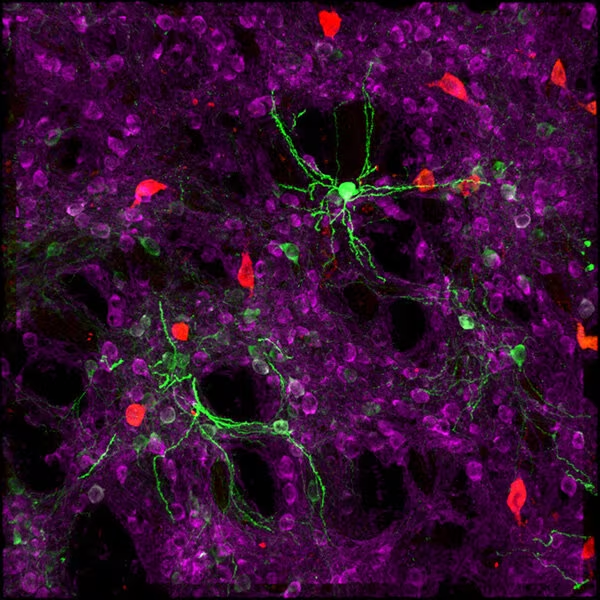
When a melody unfolds, your brain isn’t just listening – it’s predicting. Scientists recently discovered a special set of brain cells that respond only to music, not speech or noise. These “music neurons” fire as your brain anticipates what note should come next, drawing on patterns from years of listening. Their activity shifts between confirming expectations and reacting to surprises – helping to explain why a perfectly timed chorus can give you goosebumps, and why a wrong note feels instantly jarring.
i would walk five hundred (thousand) miles
listen/
I would walk 500 miles, and I would walk 500 more—but I’d still have nearly half a million to go to match the total length of the cells in my brain. Neurons are like living wires, carrying the electrical signals behind our thoughts, feelings, and behaviors. If stretched end to end, they could wrap around the Earth about 20 times. When you think about it like that, it’s no surprise there’s still so much we don’t know about the brain.
the most complex organ
listen/
The human brain is often called the most complex organ in the known universe—a frontier as mysterious as deep space or the ocean floor. Right here in Seattle, scientists at the Allen Institute are working to map every type of cell in the brain to better understand how it functions in health and disease. Because your brain is essential—you wouldn’t be listening to KEXP without it.