
impact
about
our story
explore our impact
careers and opportunities
join us
open science
sharing science to speed discovery
open science week
celebrating open science
team science
people & teams
discovery is a team effort
allenites
the people who make our work possible
advisors
their input shapes our science
board of directors
they help us fulfill our mission
shanahan foundation fellowship
at the interface of data and neuroscience
next generation leaders
fostering emerging leaders in bioscience
research
overview
our approach
science at the scale of greatest impact
publications
explore our publications
open science
sharing science to speed discovery
science accelerators
brain science
building a blueprint of the brain
cell science
understanding how cells become organs
neural dynamics
revealing the brain’s hidden algorithms
immunology
creating the ultimate immune system reference
synthetic biology
seattle hub for synthetic biology
education
overview
science education
science is for everyone
open science
sharing science speeds discovery
engagement
education resources
real science. real skills.
field trips
experience science where it happens
educator development
empowering educators
news
overview
all news
explore the latest news
podcast
the human stories behind discovery
sign up for our newsletter
stay connected to our science
events
overview
all events
public engagement, workshops, seminars and more
conferences
connect with us
science resources
science resources
allencell.org
allenimmunology.org
allenneuraldynamics.org
brain-bican.org
brain-map.org
microns-explorer.org
impact
back to menu
team science
our story
explore our impact
careers and opportunities
join us
open science
sharing science to speed discovery
open science week
celebrating open science
team science
people & teams
discovery is a team effort
allenites
the people who make our work possible
advisors
their input shapes our science
board of directors
they help us fulfill our mission
shanahan foundation fellowship
at the interface of data and neuroscience
next generation leaders
fostering emerging leaders in bioscience
research
back to menu
overview
our approach
science at the scale of greatest impact
publications
explore our publications
open science
sharing science to speed discovery
science accelerators
brain science
building a blueprint of the brain
cell science
understanding how cells become organs
neural dynamics
revealing the brain’s hidden algorithms
immunology
creating the ultimate immune system reference
synthetic biology
seattle hub for synthetic biology
education
back to menu
overview
science education
science is for everyone
open science
sharing science speeds discovery
engagement
education resources
real science. real skills.
field trips
experience science where it happens
educator development
empowering educators
news
back to menu
overview
all news
explore the latest news
podcast
the human stories behind discovery
newsletter
stay connected to our science
events
back to menu
overview
all events
public engagement, workshops, seminars and more
conferences
connect with us
science resources
back to menu
science resources
allencell.org
allenimmunology.org
allenneuraldynamics.org
brain-bican.org
brain-map.org
microns-explorer.org
search
news

Scientists use Open Ephys GUI to study how psychedelics affect the brain

Software co-created by the Allen Institute is helping scientists better understand psilocybin, which could lead to new treatments for neuropsychiatric disorders like depression

September 16, 2025
 min read
share/
(Photo credit: Ryan Young, Cornell University)
Software co-created by the Allen Institute is helping scientists better understand psilocybin, which could lead to new treatments for neuropsychiatric disorders like depression
Thank you! Your submission has been received!
Oops! Something went wrong while submitting the form.

in this article

table of contents will display on published page only
set h2 to populate the table of contents here

authors

Peter Kim
Associate Director, Communications & Media Relations

contributors

Erik Dinnel
Senior Producer

Alex Kwan, Ph.D., is a researcher at Cornell University passionate about finding new therapies for neuropsychiatric disorders like depression. In addition to his role at the school’s biomedical engineering department, he has been a faculty member in the psychiatry departments at both Yale and Cornell, where he learned about the debilitating toll of mental illness and the hopelessness many feel given the limited treatment options available to them.

“For 20 years, people have depended mostly on treatments like selective serotonin reuptake inhibitors (SSRI) or electroconvulsive therapy, things that we have used for so long; but we know that they take a while to begin working, and some people don’t respond to them very well,” said Kwan. “So it’s very exciting to have a new treatment option on the horizon.”

Using psilocybin to treat brain disorders

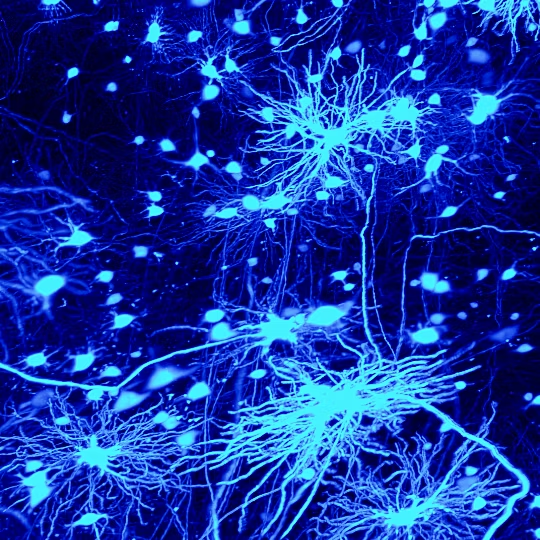
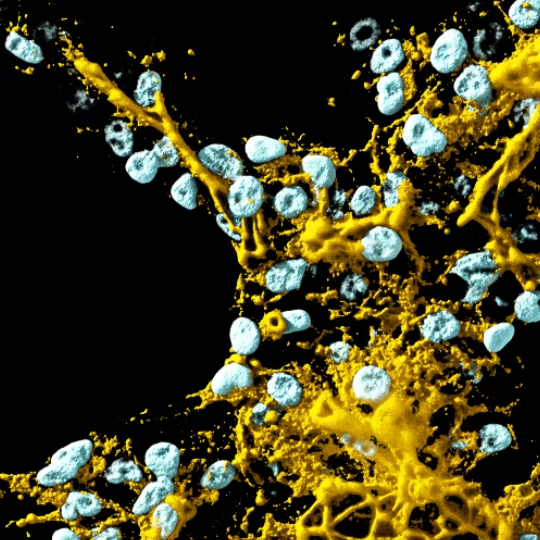
One promising treatment option could be psilocybin, a naturally occurring psychedelic compound found in certain species of mushrooms. The video shows pyramidal tract neurons in red. These cells rewire after exposure to the drug and gain new neuronal connections. A small group of them also become more active.
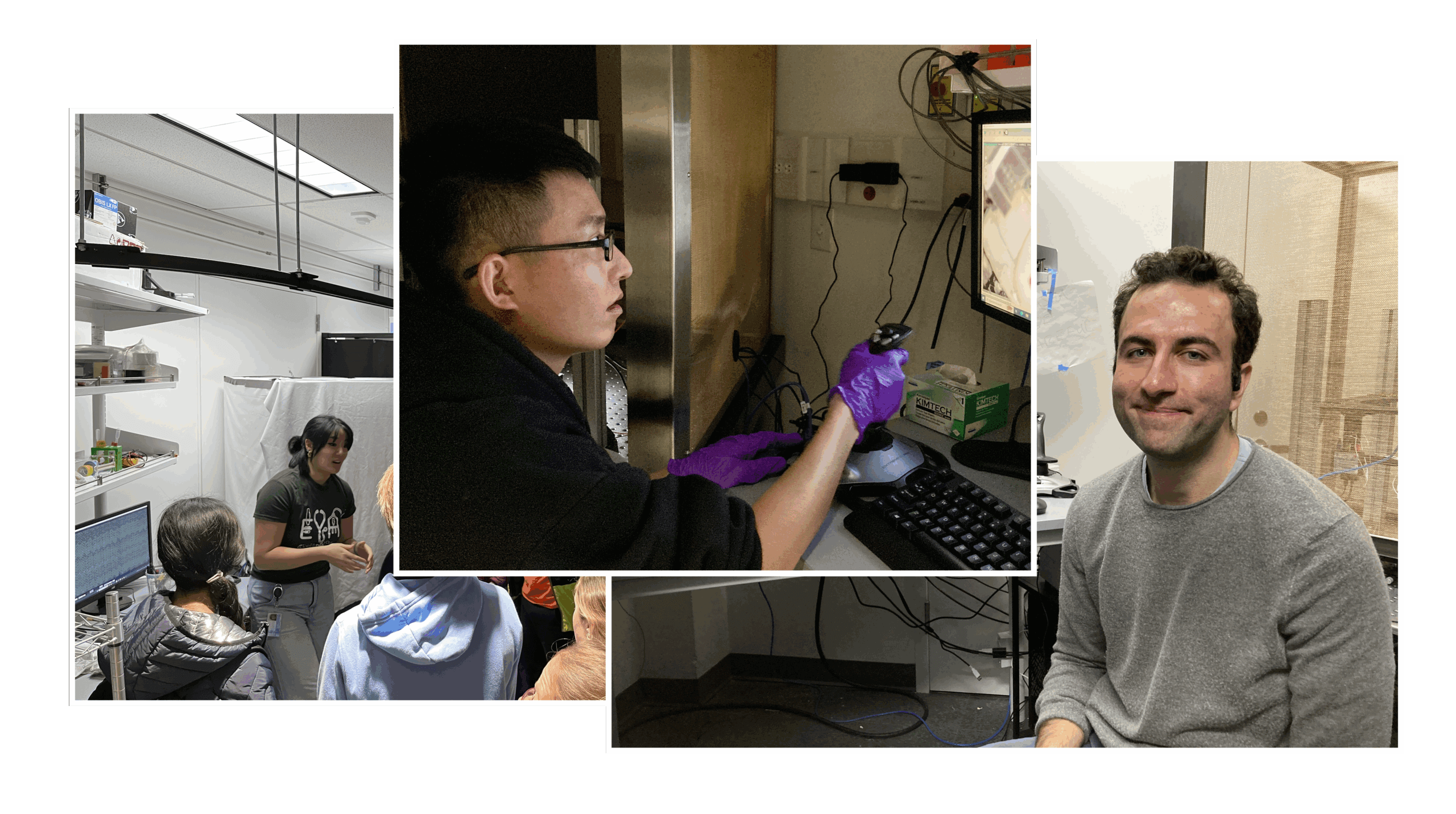
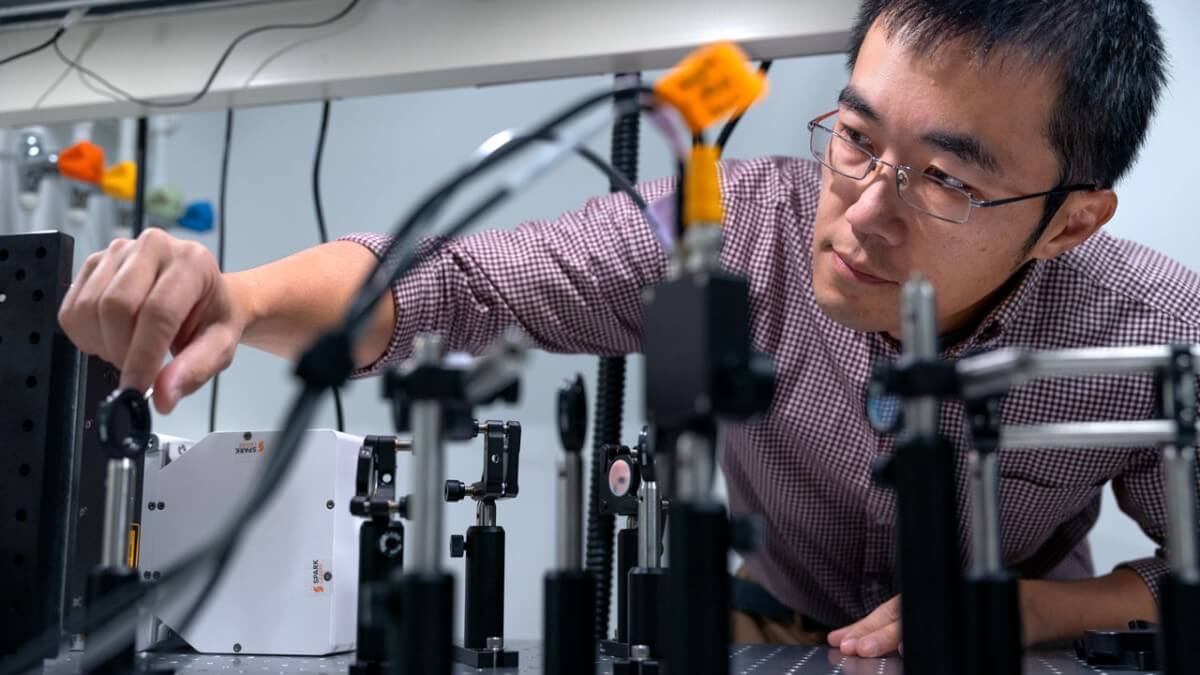
Lab researchers working with equipment and samples in scientific workspace.

Kwan’s research team, which included Cory Knox, Quan Jiang, and Pasha Davoudian,  made some of  these discoveries using Neuropixels probes to record from hundreds of mouse brain cells in real time, and an advanced open-source software package called Open Ephys GUI.

Open Ephys GUI

Open Ephys GUI (graphic user interface) was co-created by the Allen Institute and MIT. It processes and visualizes electrophysiology data captured by Neuropixels probes so that scientists can see what their data looks like. This is data related to the communications, or chatter, between thousands of brain cells sending electrical signals to one another. “Raw data is just numbers, which is not very useful to look at on its own. But if you can convert the raw data into rich visualizations with appealing colors, it becomes much more readily understandable (and interpretable),” said Josh Siegle, Ph.D., one of the lead designers and senior scientists at the Allen Institute. “This is especially important when recording from multiple Neuropixels probes in parallel, where you have data from hundreds or thousands of channels that needs to be summarized at a glance.”
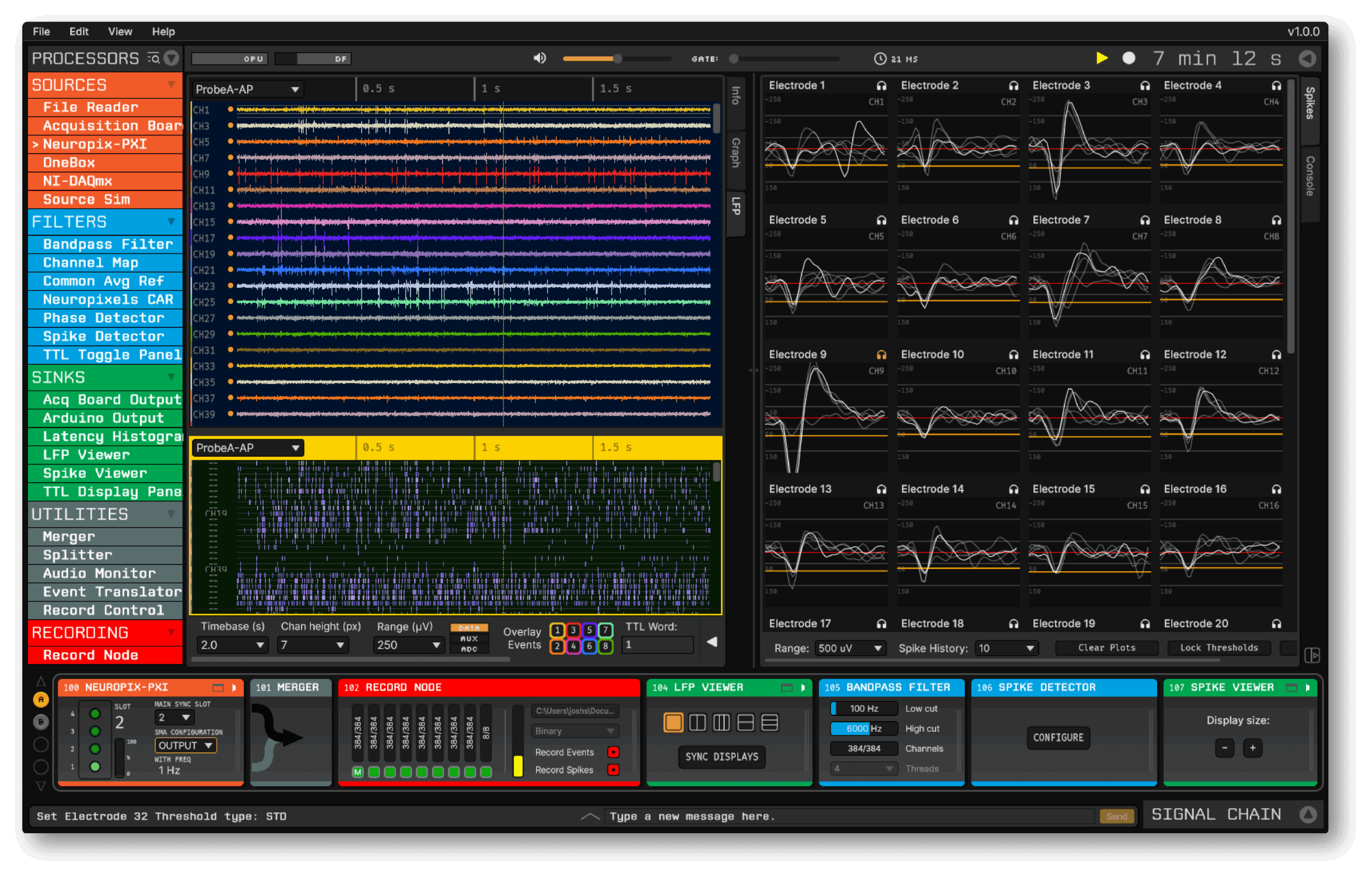
Neuroscience software interface displaying multi-channel electrode recordings and neural signal waveforms analysis

Benefits of Open Ephys GUI

The system is highly adaptable for specific experimental needs because it relies on a diverse range of plugins that the global scientific community designs, much like an online app store where developers design and contribute their own apps that others can use. “Everyone in the lab agrees just how brilliant the plugin system has been—the fact that the software is quite modular and that you can add and subtract functionality, this helps us keep the software to just the right amount of complexity, but no more or less, which I think is quite important,” said Kwan, whose team used Open Ephys GUI almost every day during the course of their study.

“In our case, we needed to tag neurons with optogenetics at the end of the experiment; so we would record them as the mouse was administered the drug, and then at the very end, we would perform opto tagging. Here, the plugins came in very handy. It was very easy to incorporate pulse pal (plugin)for laser stimulation for tagging these cell types. We just dropped it into the pipeline and then it’s right there, and it worked right off the shelf.

Other plugins include CNN Ripple, Falcon Output, LSL Inlet, and Phase Calculator. All of these perform specific functions that expand experimental capabilities.

Another benefit of Open Ephys GUI is that it’s hardware agnostic: it can work with multiple pieces of equipment and hardware, making it much more flexible than other systems. In the past, scientists were locked into one company and had to spend thousands of dollars buying their hardware and software to perform experiments and record and process data because there wasn’t compatibility between companies.

Open Ephys GUI is free for anyone to download and works on any operating system. It has been used to collect data for hundreds of scientific publications and has made extracellular electrophysiology more accessible in countries like Brazil, India, and South Africa.

“One of the very critical criteria for us is stability of the software. Open Ephys has been rock solid. Particularly for us, we had to record for a long time and it’s very important for the recording to be stable before and after the drug is administered. It’s a two-hour continuous recording; the system cannot crash,” said Kwan.

Middle-aged man smiling at camera wearing light blue collared shirt
“Scientific progress depends on a handful of indispensable open-source software tools. Open Ephys GUI is one of them—an essential driver of the revolution in multichannel neurophysiology. Its features empower a wide range of experiments, but above all, it is exceptionally robust and reliable.”

— Karel Svoboda, Ph.D., executive vice president and  director of the Allen Institute for Neural Dynamics

Advancing our understanding of the brain

Kwan and his research team are shedding valuable light onto the potential therapeutic effects of psilocybin, laying the groundwork for new drugs that could help treat depression and other serious brain disorders. Their findings—including how pyramidal tract neurons respond to the psychedelic compound—were published in the journal Nature. His team now hopes to broaden our understanding of the brain by analyzing behavioral data; and with Open Ephys GUI’s versatility, that area of investigation is ripe for discovery.

‍

Citations
No items found.

about the allen institute

The Allen Institute is an independent, 501(c)(3) nonprofit research organization founded by philanthropist and visionary, the late Paul G. Allen. The Allen Institute is dedicated to answering some of the biggest questions in bioscience and accelerating research worldwide. The Institute is a recognized leader in large-scale research with a commitment to an open science model. For more information, visit alleninstitute.org.
related news

all news
No articles for the category
we acceleratedevelopcatalyzeimpact

science done differently. shared openly.

explore our accelerators

brain science

Mapping every cell, connection, and circuit in the brain—openly shared with the world.

cell science

Decoding how cells become tissues, then programming that knowledge into powerful new research tools.

neural dynamics

Revealing the brain's hidden algorithms that transform neural activity into real-world behavior.

immunology

Creating the deepest open reference for the healthy human immune system ever built.

synthetic biology

Engineering cells to record their own histories, transforming how we understand disease over time.

research

Big questions, open answers, and science built to be shared.

education

Inspiring the next generation of scientists through open science resources.

impact

Our science is empowering researchers and advancing health worldwide.
advancing science through open, collaborative research
Get the allen institute newsletter
Stay informed on the latest breakthroughs in neuroscience, bioscience, and AI-driven research.
allen institute
impactpeople & teamscareers & opportunitiesalumnihistory & founder
science resources
allencell.orgallenimmunology.orgallenneuraldynamics.orgbrain-bican.orgbrain-map.orgmicrons-explorer.org
research
brain sciencecell scienceneural dynamicsimmunologysynthetic biologypublications
education
science educationfield tripsprofessional developmenteducation resources
quick links
newseventsopen sciencepodcastscience resourceshuman brain donationvisit uscontact
follow us/

allen institute, 615 Westlake Ave North, Seattle, WA 98109 +12065487055

© 0000 allen institute. all rights reserved.
privacy policyterms of usecitation policyemployee portalpolicy & compliancecookie settings