in this lesson
What is 2-photon calcium imaging?
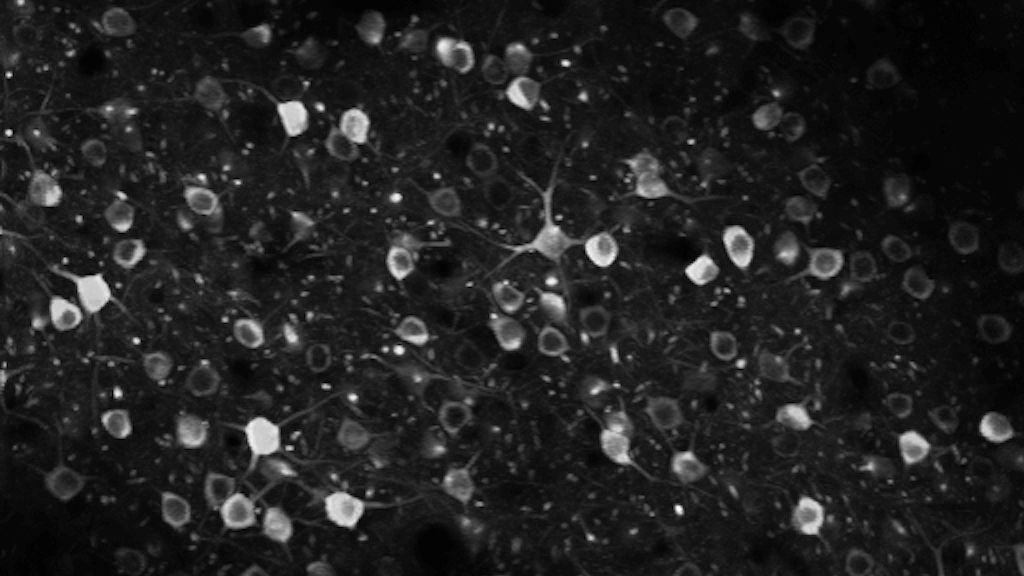
When a neuron fires, it is flooded with calcium ions. Scientists can detect this change using fluorescent molecules that glow when they bind to calcium, such as the genetically encoded GCaMP calcium indicator. Mice that have been bred to express GCaMP in their neurons undergo surgery to implant a cranial window, allowing access to the brain, and then these glowing neurons can be observed under a 2-photon microscope.
Interested in using 2-photon calcium imaging data in a course you teach?
Students can browse our openly available Visual Coding data, or engage in deeper analysis using our Python notebooks.
2-Photon calcium imaging lab tour
Video description: How can scientists watch neurons firing inside the brain of a living animal? Join us for a walkthrough of the 2-photon calcium imaging pipeline at the Allen Institute, from preparing the mice, to imaging their brains, to analyzing the resulting data. You’ll have a chance to peek into our cutting-edge facilities and meet teams of scientists working together to uncover the mysteries of how our brains function. This video focuses on data collected for the Allen Brain Observatory Visual Coding project, which is freely available to explore at brain-map.org. Video length: 8:51
How does 2-photon imaging work?
The special type of fluorescence microscope used for 2-photo calcium imaging uses an infrared laser to excite the fluorescent calcium indicators. It emits two photons of low-energy light that combine to create excitation, rather than using a single higher-energy photon as in other types of fluorescence microscopy. This allows deeper penetration into the tissue with less damage to cells. Now that the firing of individual neurons is visible, scientists can combine this neuronal activity data with information about what the animal was doing at a given moment in time, revealing the patterns of activation underlying a particular behavior.
What type of research is 2-photon imaging used for?
In the Allen Institute’s Visual Coding study, mice were presented with a variety of visual stimuli while undergoing 2-photon calcium imaging of the visual cortex to understand how visual information is processed by the brain. This powerful technique is also being applied to answer a wide variety of other questions about how the brain makes decisions, controls behavior, and perceives the world.
featured education resources